mcp-sandbox
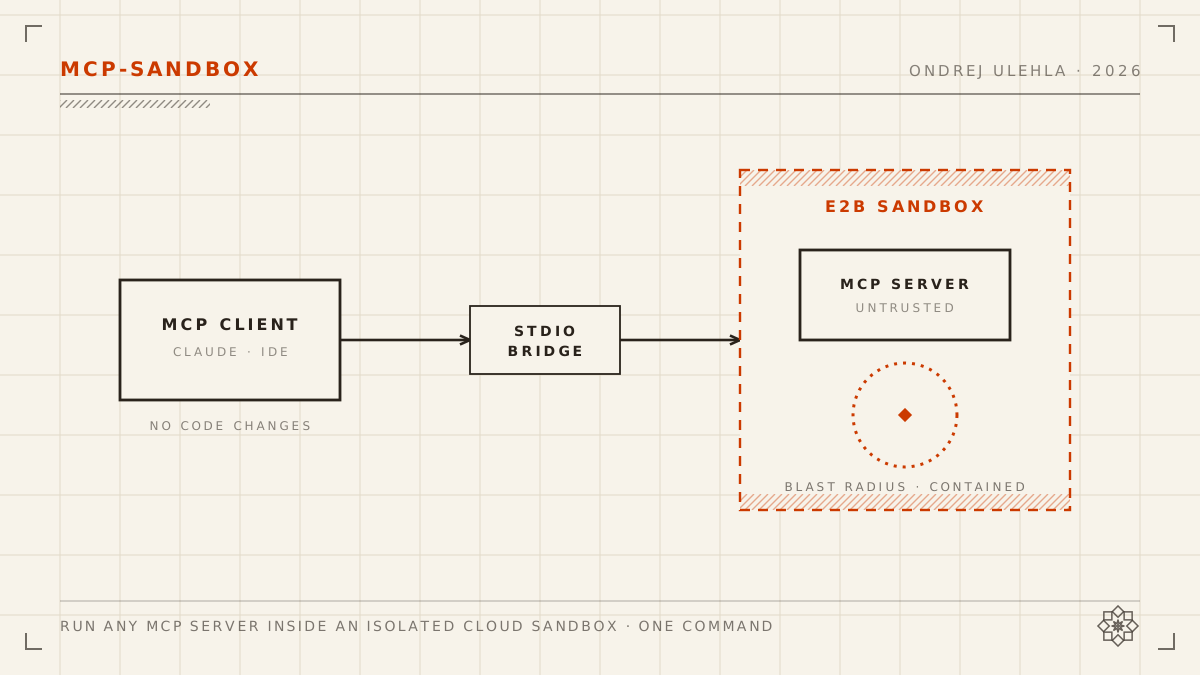
Run any MCP server inside an isolated cloud sandbox instead of on your machine – one command, no code changes. Removes the blast radius of untrusted agent tooling.
- Role
- Author & Maintainer
- Year
- 2026
Problem
People launch MCP servers straight from a registry (`npx -y whatever-mcp`) with full access to their filesystem, secrets and network – a malicious or compromised one can read everything the agent can.
Solution
A transparent stdio bridge that runs the server in a disposable E2B micro-VM. To the client it is the server; in reality it executes in the cloud with allowlist-only access to your environment.
Outcome
Verified end-to-end against a live E2B sandbox – the worst a hostile server can do is trash its own throwaway VM.
Context
MCP servers are the way agents get tools – file access, web scraping, database
queries, and more. But an MCP server is code you run with your agent’s
privileges, and the community norm is to launch it straight from a registry:
npx -y some-mcp-server. Nobody reads it first. This is the same trust problem
agent-audit detects in
configuration – here I wanted to remove the danger, not just flag it.
Problem
A malicious or merely compromised MCP server runs with everything you have:
it can read ~/.ssh, your browser profile, every secret exported in your
shell, and reach your local network. Static analysis can warn you; it can’t
contain the code once it runs.
Solution
A transparent stdio bridge. mcp-sandbox spawns a disposable
E2B micro-VM, starts the MCP server inside it, and pipes
JSON-RPC both ways:
npx mcp-sandbox run -- npx -y some-mcp-server-from-the-internetTo the MCP client (Claude Code, Cursor, …) this is the server – the protocol is bridged verbatim. But the server executes in the cloud with:
- no access to your filesystem, environment or local network
- allowlist-only env crossing (
--env KEY/--env KEY=value) – the exact inverse of the usual “inherit everything” default --tracecapturing every JSON-RPC message to JSONL for inspection- a TTL that reaps the sandbox no matter what
The bridge is line-buffered so the client never sees a partial JSON-RPC frame,
and the whole E2B integration sits behind an injected SandboxBackend
interface – so the 11-test suite runs offline with an in-memory fake.
Outcome
- Verified live: a sandboxed
@modelcontextprotocol/server-everythingcompleted theinitializehandshake and returned its 13 tools through the bridge, with traffic captured to a trace file - Blast radius gone: a hostile server can only harm its own throwaway VM
- Drops into an existing setup with zero code changes:
claude mcp add name -- npx -y mcp-sandbox run -- <server>
What I learned
The interesting bug was a cold-start race: npx downloads the package on first
run and re-execs mid-startup, so a client’s immediate initialize was lost.
Diagnosing it meant probing the sandbox directly – confirming the runtime,
isolating the unstable-PID window – and the fix (pre-install in a setup step,
run the resulting binary) came straight from understanding why the process
identity changed. Building against a real cloud runtime rewards that kind of
first-principles debugging.