Neural Networks in Virtual Reality
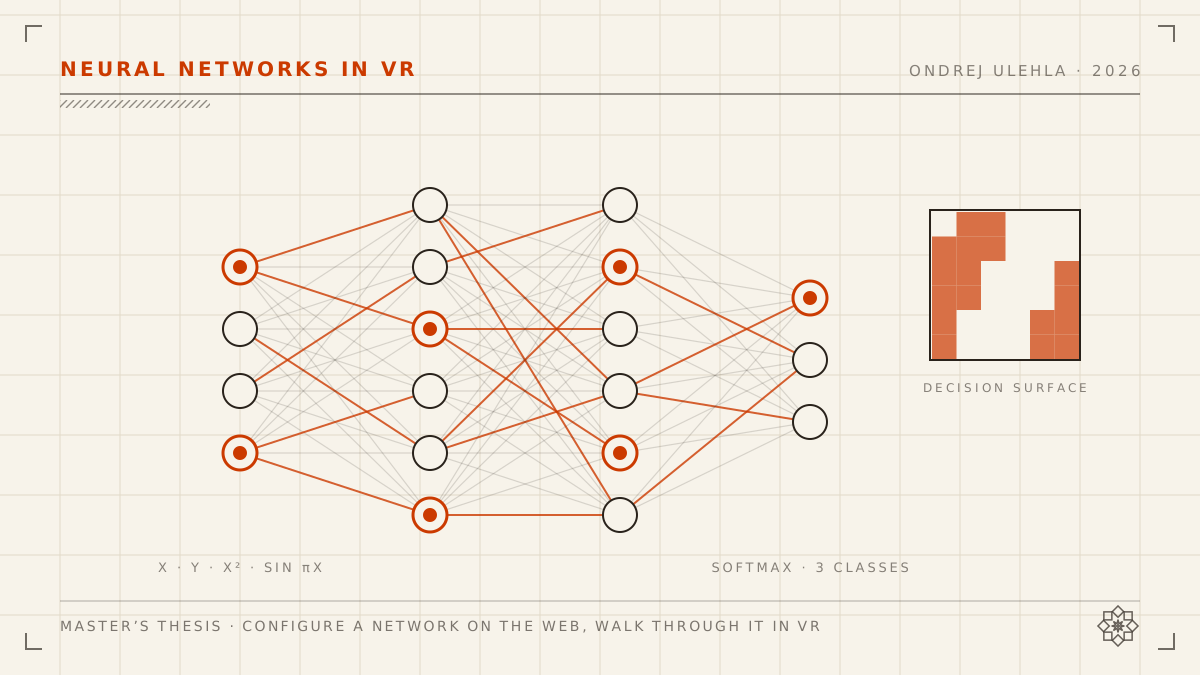
My master’s thesis: a web app that configures a neural network and a metaverse world that reads those parameters and builds a functional 3D model of the network – a “3D brain”.
- Role
- Master’s Thesis · CTU FIT
- Year
- 2025
Problem
Neural networks are taught as flat diagrams – hard to feel the architecture, the weights, or how a signal actually propagates through the layers.
Solution
A web application that encodes a network’s architecture and parameters, paired with an immersive 3D/VR environment that decodes them and generates a living 3D model used to drive objects in the scene.
Outcome
An end-to-end system connecting web technology, neural networks and virtual reality – and an interactive version you can run right here on this site.
Context
This is my master’s thesis at the Czech Technical University, Faculty of Information Technology (2025), supervised by doc. Ing. Mgr. Petr Klán, CSc. The brief: build a system that models neural networks in virtual reality – a web app encodes the network’s parameters, and a visual program in a 3D metaverse reads that data and constructs a working 3D model of the network (a “3D brain”) that can control objects in the virtual world.
Problem
Neural networks are almost always presented as static, flat diagrams. That representation hides the things that actually build intuition: the shape of the architecture, the sign and magnitude of individual weights, and how an input signal propagates and transforms layer by layer. It’s especially unintuitive for newcomers.
Solution
The thesis has two halves that talk to each other:
- A web application – the interface for defining a network: its layers, neurons, activation functions and weights. It runs the forward pass and backpropagation, generates datasets, and encodes the whole network into a compact description.
- A virtual 3D world built on the Resonite metaverse platform using visual programming. It reads and decodes the web data and automatically generates a 3D model of the network in an immersive space, where the model becomes a control element for scene objects.
Together they demonstrate automated generation of a neural-network model from parameters set in the browser – a bridge between web technologies, AI and VR.
Outcome
- A complete pipeline: configure in the browser → encode → generate the network in VR → use it to drive the 3D scene.
- The forward pass, backprop and dataset generation are all real, running code.
- Revived on this site: the original visualization site went offline, so I rebuilt its interactive core right here – open the Neural Network Lab to train a network live and watch a 3D model of it light up with its own activations.
What I learned
Making something legible is its own engineering problem. Getting a network to train is the easy half; turning weights, activations and signal flow into something a person can look at and immediately understand – in 2D and in 3D – took more design iteration than the math ever did.