URL Shortener on Microservices
A production-style URL shortener built as a microservices system – cache-first redirects, stream-decoupled analytics and full observability, one command to run.
- Role
- Backend & Infrastructure
- Year
- 2026
Problem
A simple CRUD app teaches nothing about distributed systems – I wanted to experience real service boundaries, caching, async pipelines and observability first-hand.
Solution
Deliberately over-engineered in the right way: separate shortening, redirect and analytics services behind a gateway, cache-first reads, click events over Redis Streams, metrics and dashboards built in.
Outcome
Cache-first redirects, analytics fully decoupled from the hot path, graceful degradation at the gateway – and 56 tests that run without any infrastructure.
Context
A URL shortener is famously simple to build – and famously hard to build well at scale. I used it as a vehicle to practice the parts of engineering that a monolith hides: service boundaries, caching strategy, asynchronous pipelines and observability.
Problem
The interesting problems only appear when you refuse the easy path: what happens on cache miss storms? How do you record clicks without slowing a redirect down? How do you know the analytics pipeline silently broke – and how does the system behave when it does?
Solution
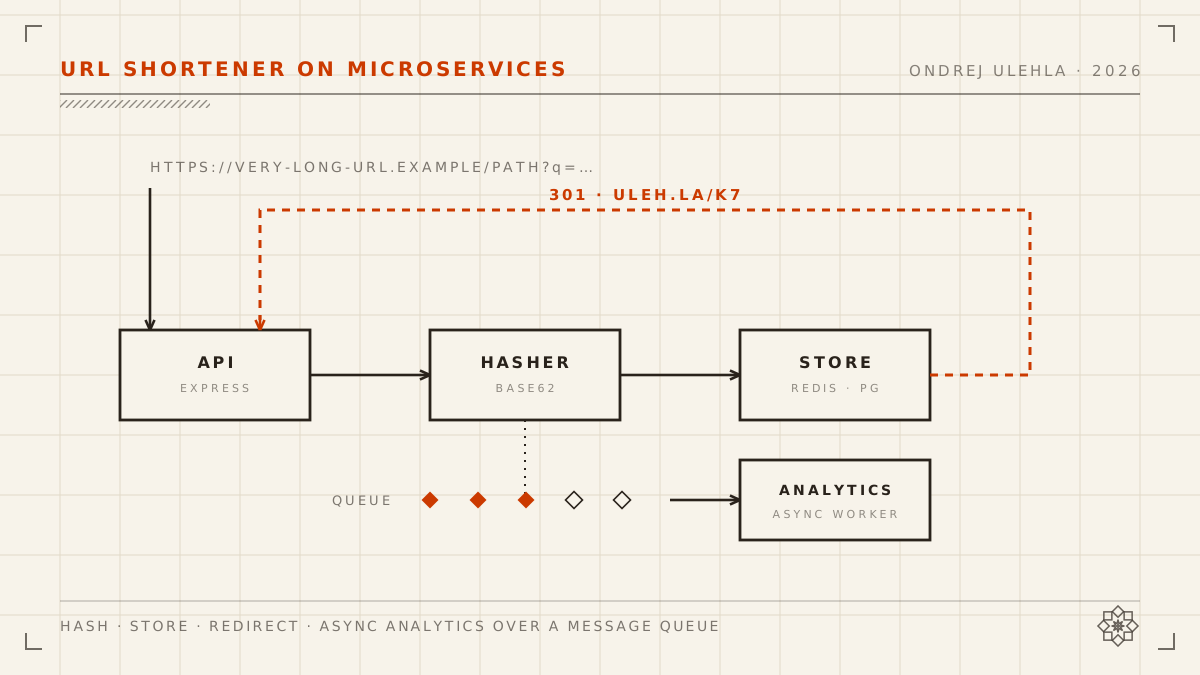
Three services and a gateway, each with a strict contract:
- Shortener service – write path: validation, collision-safe base62 code generation, PostgreSQL storage
- Redirector service – hot read path: Redis cache-first with Postgres fallback; every hit fires a click event onto a Redis Stream without ever blocking the redirect
- Analytics service – a consumer-group reader aggregates the stream into daily rollups; stats API serves totals, trends and top referrers
- API gateway – the only public surface: rate limiting, request-id propagation, and an overview endpoint that degrades gracefully (URL info still answers when analytics is down)
The whole stack runs from one docker compose up – Postgres, Redis, all four services,
Prometheus scraping every /metrics, and a provisioned Grafana dashboard for request
rate and p95 latency. Kubernetes manifests ship as reference configuration. Every
service logs structured JSON, exposes real /health checks and shuts down gracefully.
Outcome
- Cache-hit redirects never touch the database; analytics never touches the hot path
- The gateway keeps answering – degraded, flagged, but up – when a downstream dies
- 56 tests run with no infrastructure at all: every service exports
createApp(deps)and the suites inject in-memory fakes - Golden-signal dashboards out of the box
What I learned
Observability is a feature you build first, not last – and the second best design decision was dependency injection everywhere: a system you can fully test on a laptop with nothing running is a system you actually understand.